
How to Measure Windows for Blinds: A Practical Dubai Method
How to measure windows for blinds starts with one simple rule: record the width first, then the height, at three points each, and use the smallest number. That’s the direct answer. Getting the numbers right means your blinds fit neatly inside the frame or overlap it cleanly, with no gaps for Dubai’s afternoon sun.
Key takeaways
- Measure width at top, middle, and bottom; use the narrowest width.
- Measure height at left, center, and right; use the shortest height.
- Decide between inside mount and outside mount before you start.
- Round every measurement to the nearest 1/8 inch or millimeter.
- Double-check each number before you order from 99 Blinds.
Window measurement is the process of recording the exact dimensions of a window opening so a blind or curtain can be cut to fit it properly. In Dubai, where villas and apartments often have recessed windows, floor-to-ceiling glass, and arched frames, a careful FAQ | Blinds & Curtains in Dubai page helps answer the first questions most homeowners ask. You don’t need special training. You need a metal tape measure, a pencil, and about ten minutes per window.
This guide walks through the steps in order: the tools, the two mounting styles, exact measuring methods for each, and the mistakes that send people back to the store. If you’re measuring a standard rectangular window in a bedroom or a wide living-room opening, the process is the same. The details change slightly for roller blinds, fabric blinds, and blackout curtains, and those differences are covered in later sections.
Tools You Need Before Measuring

You don’t need a workshop full of gear to measure for blinds. Four simple items cover almost every window in a Dubai apartment or villa, and each one prevents a specific mistake that leads to ill-fitting blinds.
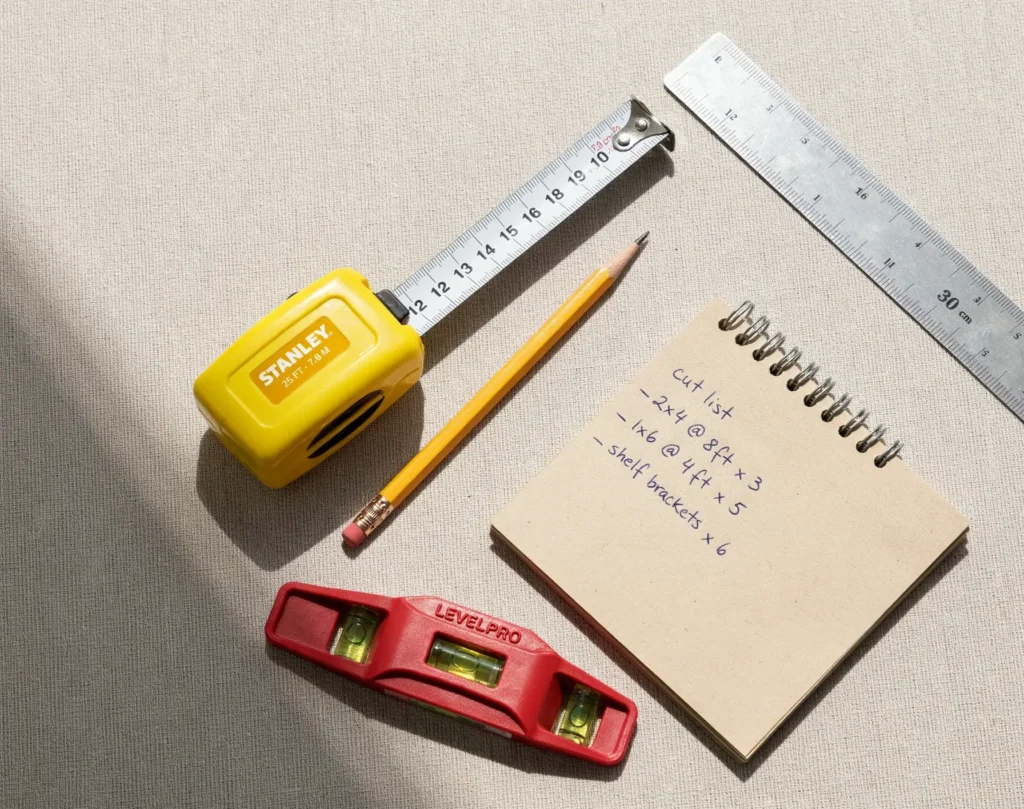
- Metal tape measure: A cloth or plastic tape stretches, which throws off readings by several millimetres. A rigid metal tape with a locking button gives the same number every time, and its narrow blade fits into tight window recesses where a bulky tape won’t go.
- Pencil: Use a sharp pencil, not a pen. Pen marks bleed into painted frames and are hard to remove. Pencil lines wipe off cleanly after the blinds are installed, and a fine point lets you mark exact positions for brackets.
- Paper: Write down every measurement as you take it. Memory fails, especially when you’re measuring five or six windows in one afternoon. A simple table with columns for width, height, and mount type keeps the numbers straight when you order.
- Step stool: Tall windows in Dubai villas often start above eye level. A stable step stool gets you close enough to read the tape accurately at the top of the frame, where the most important measurement happens.
Keep a spirit level nearby too. It’s not strictly a measuring tool, but it confirms the window frame is square before you trust your numbers. If the frame is out of level, the blinds will hang crooked no matter how carefully you measure.
Inside Mount vs Outside Mount: Which Should You Choose?

Before you measure for blinds, you need to decide whether the blinds will sit inside the window recess or on the wall around it. Inside mount means the blind fits within the window frame, leaving the surrounding wall and trim visible. Outside mount means the blind is wider and taller than the opening, covering the frame and part of the wall. The choice changes every measurement you take, so settle it first.
Inside mount suits most Dubai apartments and villas with deep, square window recesses. It looks cleaner because the blind sits flush with the wall, and it works well with sheer curtains layered over the top. You need enough recess depth for the blind’s brackets, usually at least 50 to 60 mm for roller blinds and more for wooden or fabric styles. If your window is shallow or the frame is uneven, inside mount can leave gaps at the sides where light sneaks through.
Outside mount is the better call when the recess is too shallow, the window is out of square, or you want to block more light. It also makes a small window look larger, because the blind extends beyond the opening. In Dubai bedrooms, many homeowners choose outside mount for blackout curtains and blinds, since the overlap seals the edges against strong morning sun. The trade-off is that outside mount covers decorative trim and takes up a little wall space above the window.
Your choice also affects the numbers you record. For inside mount, you measure the exact width and height of the recess at three points and use the narrowest width. For outside mount, you measure the area you want the blind to cover, then add overlap, usually 50 to 100 mm on each side. A window sheer curtain layered over an inside mount blind is a common Dubai combination, but the blind measurement itself stays independent of the curtain track. If you are unsure which mount your window can support, the team at 99 Blinds can check the recess depth during a site visit before you commit to a size.
How to Measure for Inside Mount Blinds
Inside mount blinds sit inside the window recess, so the frame itself becomes the border. This is the cleaner look for most Dubai apartments and villas, but it only works when your window recess is deep enough to hold the blind’s headrail and brackets. Measure the width first, then the height, then check the depth before you order anything.
For width, measure the inside of the window frame at three points: the top, the middle, and the bottom. Use a metal tape measure, not a cloth one, because cloth stretches and gives you a false reading. Write down all three numbers. The smallest of the three is your width measurement. That’s the number you’ll give to 99 Blinds when you order, because the blind needs to clear the tightest point in the frame.
For height, do the same thing on the left side, the center, and the right side. Measure from the top inside edge of the frame down to the sill or the floor, depending on where you want the blind to stop. Again, record all three numbers and use the smallest one. This prevents the blind from dragging on the sill or leaving a gap at the top.
Depth is the step most people skip, and it’s the one that causes the most returns. Inside mount blinds need enough recess depth for the mounting brackets and the headrail to sit fully inside the frame without sticking out past the wall. For most roller blinds, you need at least 50 mm of depth. For fabric blinds, plan for 60 to 75 mm. For vertical blinds, you’ll need closer to 90 mm. Measure the depth at the top of the recess where the brackets will actually sit, not at the bottom, because frames often taper.
If your depth comes up short, don’t force an inside mount. Switch to an outside mount instead, which we cover in the next section. A blind that juts out past the wall looks unfinished and catches dust along the edges. The team at 99 Blinds can confirm your measurements over a quick call or WhatsApp message before you place the order, which saves you from ordering a blind that doesn’t fit.
How to Measure for Outside Mount Blinds
Outside mount blinds cover the window frame plus a bit of wall around it, which makes them the right choice when the window recess is too shallow for an inside mount or when you want to hide an uneven frame. Measuring for outside mount is simpler than inside mount because you work from the wall surface, not the recess. Start by deciding how far past the window opening you want the blind to extend. Most Dubai homes look best with 5 to 7 cm of overlap on each side, though wider windows can take up to 10 cm without looking bulky.
Measure the width first. Run your tape measure across the window opening at the top, middle, and bottom, then use the widest of the three. Add your chosen overlap to both sides. If the window is 120 cm wide and you want 6 cm of overlap on each side, your total blind width is 132 cm. Write that number down before you move on.
For the height, measure from the point where you want the top of the blind to sit down to where you want the bottom to fall. Most people mount outside blinds 5 to 10 cm above the window frame so the headrail has room to sit flat against the wall. At the bottom, decide whether the blind should stop at the sill or extend past it. Blinds that extend 5 to 8 cm below the sill block more light and look more finished.
Obstructions change the math. If there is a handle, a window crank, or a protruding sill, the blind needs to clear it. Measure the distance the obstruction sticks out from the wall, then add that to your depth allowance. For a crank handle that projects 4 cm, you need a mounting bracket deep enough to hold the blind at least 4 cm off the wall. The team at FAQ | Blinds & Curtains in Dubai can confirm bracket depths for specific blind models before you order.
Check the wall surface too. Outside mount blinds need flat, solid wall above the window for the brackets. If the wall is uneven or tiled, measure from the highest point so the headrail sits level. For fabric blinds, add 2 cm to the width for the fabric stack, because fabric blinds gather more fabric at the top than roller blinds do.
Record every measurement in centimetres and round up to the nearest half centimetre. A blind that is slightly wide can be adjusted; one that is too narrow leaves a light gap you cannot fix.
Measuring for Different Blind Types
Once you have the basic width and height, the next step in how to measure windows for blinds is adjusting for the specific product. Roller blinds sit inside the frame most of the time, so you want the tightest accurate measurement at three points: top, middle, and bottom. Use the narrowest width and the shortest height from those three readings. A roller blind that is 2 mm too wide will scrape the frame every time you pull it down.
Fabric blinds need a little more thought because the fabric stacks when raised. For an inside mount, measure the recess width at the top where the headrail will sit, then check the depth to make sure the folded stack clears the window handle. If the recess is shallow, go outside mount and add 10 cm to the width so the stack hangs clear of the glass. Our other brands Dubai | Buy Best Roman Curtains range includes a measuring note with every order, but the rule is simple: width first, then drop, then depth.
Blackout curtains are usually mounted on a track or pole above the window, not inside it. Measure the pole length, not the window width, and add 15 to 20 cm on each side so the curtains can stack back without covering the glass. The drop runs from the bottom of the rings to the floor, or to 2 cm above the floor if you want a clean line. Our Blackout Curtains Dubai | Custom Made & Fitted team checks this on site, but measuring it yourself first gives you a realistic budget.
Sheer curtains follow the same pole-to-floor logic, but the fabric is lighter and gathers more. For a full, soft look, order the width at two to two and a half times the pole length. A 200 cm pole becomes a 400 to 500 cm sheer panel. If you are pairing sheers with blackout curtains on a double track, measure both tracks separately because the outer track sits a few centimetres wider. Our Window Sheer Curtains Dubai | Custom Sheers guide shows the exact stack-back allowance for each heading style.
One more thing: motorized blinds use the same width and height as manual ones, but the motor housing adds depth at the top. Check that the recess is at least 7 cm deep before you commit to an inside mount. If it is not, an outside mount is the safer call.
Common Measuring Mistakes That Cost You
Most measuring errors come down to three habits: using the wrong tool, rushing the job, and mixing up numbers. A cloth tape measure stretches, so your width reading can drift by several millimetres without you noticing. Use a rigid metal tape instead, and pull it snug but not tight against the window frame.
Measuring once is another trap. Write down every number, then measure the same spot a second time. If the two readings don’t match, measure a third time and use the middle value. This catches slips of the hand and misread markings before they turn into blinds that arrive too narrow or too wide.
Depth gets forgotten more often than you’d think, especially on inside mounts. A window that looks deep enough for a 50 mm bracket can be shallower at the top than at the bottom, and that difference matters. Check depth at three points: left, centre, and right. Use the smallest number as your working depth.
Swapping width and height is the classic late-night mistake. Always record width first, then height, and label each number clearly. A quick habit that helps is writing “W” and “H” next to every measurement, even on a scrap of paper. When you order, double-check that the width you enter matches the width you wrote down.
Rounding up to the nearest centimetre feels safe, but blinds are cut to the millimetre. Give the fabricator your exact measurements, not a rounded guess. If you’re unsure about a tricky window, our team at 99 Blinds can walk you through the numbers before you commit to an order.
Using a Blind Size Calculator
A blind size calculator turns your raw window measurements into a finished blind width and height, subtracting the right clearance for brackets and operating mechanisms. You enter the exact opening size, pick inside or outside mount, and choose the blind type. The tool then applies the standard deductions, usually 6 to 12 millimetres per side for inside mounts, so the blind glides without scraping the frame.
Most calculators ask for three inputs: the measured width, the measured height, and the mount style. Some also ask for the number of panels or the control side, which matters for motorized blinds. You still need a steel tape measure and a level before you open the calculator, because the tool cannot fix a bad starting number. If your window is more than 5 millimetres out of square, measure at the top, middle, and bottom, then enter the narrowest width.
Use a calculator when the window is a standard rectangle and the frame is in good condition. Skip it for bay windows, arched tops, or recesses with uneven plaster, where manual measurement and a quick photo to a fitter save more time than any formula. 99 Blinds includes a free measurement check with every order, so the calculator is a useful first pass, not the final word.
Window Measurement Guide for Dubai Homes
Dubai homes don’t all measure the same way. A villa in Arabian Ranches has deep plaster recesses. A JLT apartment has slim aluminum frames. A Palm Jumeirah villa might have floor-to-ceiling glass with barely any frame at all. Your window measurement guide has to account for those differences before you order anything.
Villa recesses are usually the easiest to work with. The plastered opening gives you a clean box to measure inside, and the depth is often enough for a full inside mount. Measure the width at the top, middle, and bottom of the recess, then use the narrowest number. For height, measure left, center, and right, then use the shortest. That’s the same rule everywhere, but villas reward you with more consistent recesses.
Apartment frames are trickier. Many Dubai towers use aluminum frames with a shallow lip, sometimes only 15 to 20 millimeters deep. That’s too shallow for most inside mount brackets. You’ll usually need an outside mount, which means measuring the frame’s outer edge and adding at least 50 millimeters on each side for proper light control. Humidity matters here too. In a kitchen or bathroom, wood blinds can swell, so measure with a little extra clearance if you’re set on wood.
That’s why 99 Blinds sends a technician for a final check before production. A steel tape and a steady hand get you close, but a professional measurement catches the frame warps and recess quirks that a quick DIY pass misses. If your window has any doubt at all, a Contact Us for Custom Blinds & Curtains Dubai visit saves you from a remake.
Curtain Measurement Dubai: What's Different
Curtain measurement Dubai follows a different logic than blind measurement. Blinds sit inside or just outside the window frame and need tight tolerances. Curtains hang from a rod, so you measure the rod position first, then the drop from the rod to the floor. The window itself matters less than where you want the fabric to fall.
Start with rod placement. Mount the rod 10 to 15 cm above the window frame and extend it 15 to 25 cm past each side. This lets the curtains stack back without covering the glass when open. If you want a taller look in a villa with high ceilings, push the rod closer to the ceiling line. The extra height makes standard windows feel larger, which matters in Dubai apartments where ceiling heights vary between buildings.
Fullness is the second difference. Blinds are cut to exact width. Curtains need extra fabric to create folds. Multiply the rod width by 2 for a tailored look or by 2.5 for a fuller drape. A 200 cm rod becomes 400 to 500 cm of fabric. Skimping on fullness saves money but leaves curtains that look flat and cheap when closed.
Floor clearance depends on the style. For standard curtains, measure from the rod to 1 cm above the floor so the fabric hangs clean without dragging. For a puddled look, add 5 to 15 cm of extra length. In homes with marble or tile floors common across Dubai, a slight break of 2 to 3 cm works well and hides minor floor unevenness. Measure the drop in three places, left, center, and right, because floors are rarely perfectly level. Use the shortest measurement unless you want a deliberate puddle.
Sheer curtains follow the same rod rules but often need less fullness, around 1.5 to 2 times the rod width. Blackout curtains need more fabric to block light properly, so stick closer to 2.5 times fullness. For custom work, 99 Blinds measures on site and accounts for rod height, floor type, and how the curtains will stack, which removes the guesswork from curtain measurement Dubai projects.
When to Call a Professional
Most Dubai apartments and villas have standard rectangular windows, and a careful DIY measurement works fine for those. You can measure for blinds in under 20 minutes if the frame is square and you have a steel tape. But some situations genuinely justify a pro.
Call 99 Blinds when the window is arched, bay-shaped, or recessed into a deep reveal. Large floor-to-ceiling glass panels, motorized blinds with hidden wiring, and blackout requirements in bedrooms all benefit from a professional measure. If two measurements of the same width differ by more than 5 mm, stop and get help rather than guessing.
99 Blinds offers free measurement and installation across Dubai and the UAE. The team checks for uneven walls, obstructions like handles or AC vents, and confirms the right mounting depth before ordering. That step alone prevents most reorder costs. For complex jobs, the Contact Us for Custom Blinds & Curtains Dubai page is the fastest way to book a site visit.
Frequently Asked Questions
What tools do I need to measure windows for blinds?
A steel tape measure works best because it stays rigid and won’t sag over long spans. You’ll also want a pencil, paper, and a step stool for high windows. Avoid cloth measuring tapes, which stretch and give readings that are off by several millimetres.
Should I measure in inches or centimetres?
Most Dubai suppliers quote in millimetres, so measure in millimetres and record width first, then height. If you’re ordering from an international site, convert carefully. One wrong conversion is the most common reason blinds arrive too narrow or too short.
How accurate do my measurements need to be?
Accuracy matters down to the millimetre for inside mounts, because the blind must clear the window frame without scraping. For outside mounts, you have more tolerance, but a 5 mm error can still leave light gaps at the edges. Measure twice and write down every figure before ordering.
What if my window isn’t perfectly square?
Older Dubai villas often have frames that are slightly out of square. Take the width at the top, middle, and bottom, then use the narrowest measurement for an inside mount. For an outside mount, use the widest measurement so the blind fully covers the opening.
Can I measure for motorized blinds the same way?
Yes, the measuring process is identical for motorized and manual blinds. The only extra step is checking that a power source or battery compartment will be accessible once the blind is installed. 99 Blinds confirms this during the site visit for motorized orders.
Do I need to remove existing blinds before measuring?
You don’t have to remove them, but you do need to measure the window opening itself, not the old blind. If the current blind is an outside mount, measure the frame behind it. If it’s an inside mount, measure the recess the blind sits in.
Is it better to measure in millimetres or use a blind size calculator?
A blind size calculator is a helpful starting point, but it can’t account for frame irregularities or obstructions like handles and tiles. Use the calculator for a rough estimate, then confirm every figure with a physical tape measure before you place the order.
What happens if my measurements are wrong?
Most custom blinds can’t be returned once cut, so a measuring error usually means paying for a replacement. That’s why 99 Blinds offers a free professional measurement service across Dubai. If you’re unsure, book a site visit and let a technician take the final figures.